


Another Day At The office
Written by – Cory DLG
Art by – Joaquin Gonzalez Ruiz
Lettering by – Fairplay Lettering
This comic is suitable for teens and up
I really wanted to like this comic. Like my own, it looks at the reality of superheroes existing in the world and examines how the way they might fit into it would differ from the typically accepted mythos presented by mainstream comics. Unlike Zip, Another Day at The Office shows us this world from the perspective of a protagonist without powers: a big city cop whose job has been rendered meaningless by caped crusaders.
It’s an interesting premise and one I was looking forward to reading. The trouble is that once the premise has been established the story doesn’t do much with it. Throughout the introductory prologue issue our leading man Detective Marcus Shitely is routinely beaten to the punch whenever his duty calls.

But that’s about all that really happens. Shitely finds himself in proximity to a crime, he attempts to react to this crime, and then a superhero shows up and steals his thunder. He looks mildly annoyed about this. Rinse and repeat.
The result is a story which repetitively moves forward at a snail’s pace, with the focus on a passive main character in the form of a straight man with no counterpart for his no-nonsense attitude to bounce off of. It’s true that there are larger than life superheroes which pop up throughout, but they come and go, and we barely know anything about them except for what we hear in exposition.

Which brings me to the next big cardinal law of writing which this title unfortunately breaches: show don’t tell. Due to the fact that the story hinges upon Shitely being overshadowed by the superheroes of his city, this typically means that anytime something exciting happens, it occurs completely off panel. While this could work, as sometimes what you don’t see is funnier than what you do, we haven’t seen what these heroes look like in action, so we have no context to imagine what it might look like when we can’t see what they’re doing.
In fact, Another Day At The Office’s prologue issue opens with a long talky scene in a diner, which sadly sets the tone for what you can expect from the story’s direction quite well. This comic is people talking, and things going on out of view, just to their left.
To explain this a little better, I want to you to picture some well known characters: let’s start off with Shaggy and Scooby Doo. Say you were watching a cartoon featuring this pair being chased by a man in a Halloween mask. They all run into a room, and we don’t see what’s going on inside, but we do hear shrieks, loud crashes, and glass breaking from within.
Now, it’s easy for us to guess what’s going on in there, because everybody knows exactly who Shaggy and Scooby Doo are, and that means we all know how they’re likely to act. We can picture them running into that room and shrieking in terror, possibly in total overreaction to a relatively mild threat, and breaking everything as they scramble to escape. We have enough information to extrapolate our own comedy from that setup, and the slapstick is arguably funnier than anything we could actually ever see.
Now imagine that same scenario with Batman. The shrieks are instead probably going to belong to man in the Halloween mask, and the comedy instead becomes the fact that he believed he had the upper hand, only to discover that he’d bitten off far more than he could chew when Batman lured him into a corner and fought back. Again, we don’t need to see it for it to be funny. Try it with Homer Simpson. Try it with Steve Urkel. Try it with any character you know lots about.
Now try it with Bob.
“Bob? From where?”
Oh, from nowhere. Just Bob.
You’ll find that the difficulty in getting any humour out of ‘Bob’ being chased into a room with a masked man where we can’t see him, is that we don’t know anything about Bob. Is he cowardly, like Scooby Doo? An unflappable martial artist, like Batman? An impulse dolt, like Homer? Or an accident prone nerd like Urkel?
We just don’t know. So how can we infer anything humorous when we don’t see what he’s doing? And yet, this is essentially the scenario which Another Day At The Office presents us with over and over.
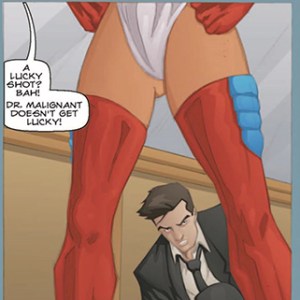
Yet despite this, reading the prologue I felt as though each scene was setting up a punchline. I kept reading, and the punchline never came.
Even the comedy we do see is woefully understated. The comic’s art is competent, but lacking identity. Detective Shitely appears to be stoic to a fault, as he never really displays all that much engagement with the crazy things happening around him beyond mild irritation, and even that’s a little difficult to ascertain because as artist Joaquin Gonzalez Ruiz has drawn him, he doesn’t seem to be particularly expressive.
It strikes me that the art style is simply too middle of the road. Not cartoonish enough to make the characters’ reactions wacky, and not angsty enough to make them ridiculously melodramatic. Which is a shame, because I think that had the artwork been a bit more decisive, the problems with the script could have at least somewhat been mitigated.
Speaking of angst, the funniest character in the entire book is The Shroud, who has the advantage of being a clear parody of Batman, one the aforementioned examples above. He takes the spotlight of Another Day At The Office’s best character, simply because we have enough context from the source material being lampooned that his jokes are among the few which actually work.

To top it all off, I’m not even convinced I really know all that much more about our protagonist Detective Shitely than we do about good ol’ Bob up there. Marcus Shitely is a police officer who does things by the book and doesn’t appreciate superheroes taking the law into their own hands – but why?
Is he driven by strongly held ideological beliefs in due process and the strength of the system? Was his old partner killed on-duty, and it was a superhero who failed to help him? Does he just want a promotion so he can finally get that really nice corner office?
We just don’t know.
I’m not suggesting that the comic come right out and tell us everything in the first issue. After all, it took Inspector Nicolas Angel an act and a half of character development to really open up, but what I am saying is that we need something.
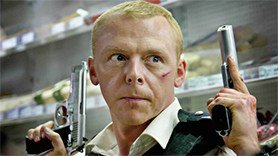
Hypothetically, what does a good day actually look like for Shitely? What are his goals in life? If he weren’t being undermined by outside forces, what is his style of policing?
We have no idea who he really is. That fact makes his frustration difficult to relate to, and therefore: difficult to laugh at. Moreover, it makes his story difficult to care about.

Another Day At The Office is available for digital download on Gumroad. Writer Cory De La Guardian currently has a live Kickstarter campaign for his new project DMA: The Department of Metahuman Affairs.
Note: I had difficulty tracking down the team on this book. If you worked on it and would like me to link to your website, social media page, or portfolio, please contact me here.






 Zip
Zip 
Leave a comment